Messianic Jews are Jewish people who believe Yeshua (Jesus) is the Messiah. Some of them celebrate Christmas, but ‒ for a number of reasons ‒ some do not.
For most Jewish Believers in Yeshua, Christmas was not a part of their family traditions. They grew up in homes that observed the Jewish holidays rather than Christmas and Easter. And, after coming to faith in Yeshua, some Messianic Jews do not feel the need to begin celebrating it.
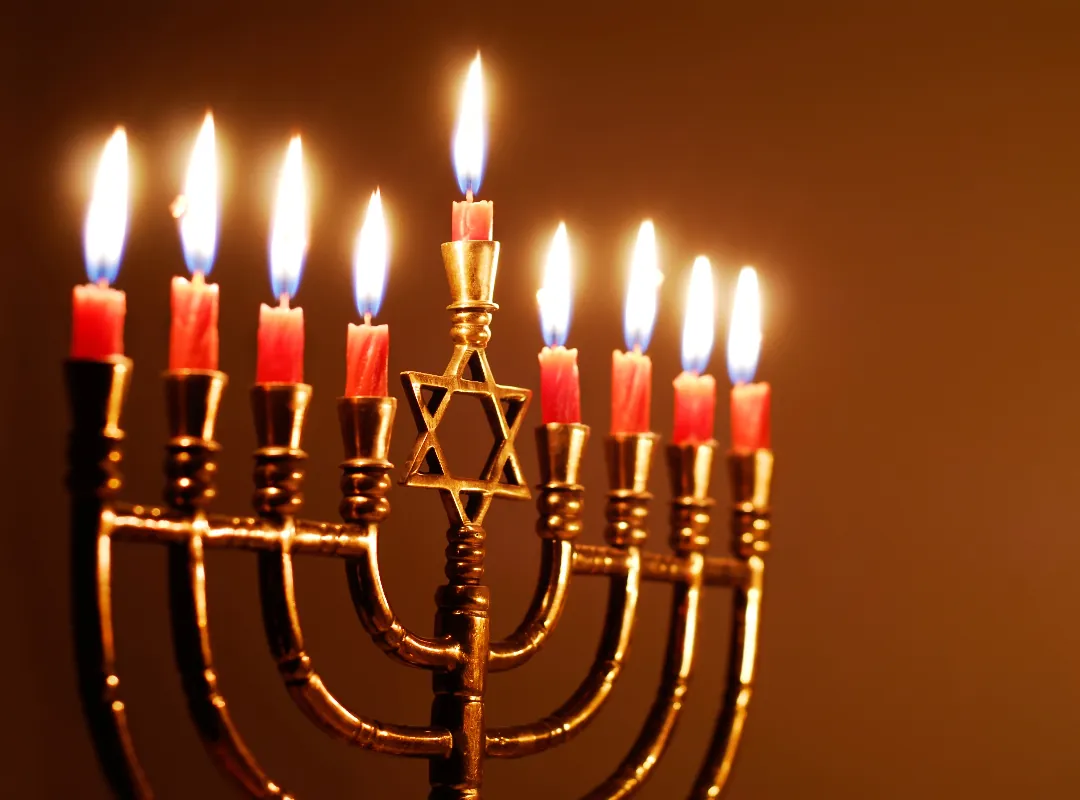
The Jewish holiday of Chanukah falls near Christmas each year. It commemorates a miracle of light in Israel’s history and is therefore also called the Festival of Light. Chanukah holds rich symbolism that can be seen to point to Yeshua, the Light of the World. This leads many Messianic Jews to honor His coming at Chanukah rather than Christmas.
However, there’s a growing segment of Messianic Jews who grew up in mixed families – Christian and Jewish – and celebrated both Christmas and Chanukah. Mixed-family Messianic Jews likely continue that tradition into their marriages and with their own children.
The Church, in 325 C.E. under Constantine, went to great lengths to separate faith in Yeshua from its natural and biblical Jewish identity. The Crusades further segregated belief in Yeshua from its Jewish foundation by violently persecuting Jewish people if they did not forsake Judaism and “convert” to Christianity.
As a result, the Jewish community views Christmas and Easter as holidays of a different religion that are not for Jewish people. Many Messianic Jews believe that celebrating Christmas could easily contribute to their Jewish families and friends believing that they have “stopped being Jewish" and “converted” to a different religion.
Messianic Jews long for their Jewish brethren to come to faith in Yeshua as the prophesied Messiah, so they are sensitive to anything that hinders openness to Him based on historical realities or perceived misconceptions.
Most Bible scholars agree that Yeshua was not born on December 25. Based on various scriptural details and time calculations, many believe Yeshua was around the Feast of Booths, or Sukkot (Soo-KOTE), in the fall. Others deduce that it was in the spring, around Passover.
So, why is Yeshua’s birth celebrated on December 25? The date was chosen at a time when Gnosticism was extremely popular. Gnosticism held that only the spirit is good and that all matter is evil, including our bodies. This led to excessive lifestyles: If the body is evil anyway, why not indulge? Gnostics held an annual celebration at the onset of winter, during which followers reveled in the depravities of the material world.
One of the central tenets of faith in Yeshua is that He came in human form. Gnostics, however, denied the birth of Yeshua, saying that He couldn’t be all good if He possessed a body. The Church chose December 25 to celebrate the birth of Messiah as a way to counter Gnosticism.
“It’s not that the Church had any special interest in December 25th,” said Rabbi Jack Zimmerman, a staff member at Jewish Voice Ministries International. “Except, if you wanted to drown out the pagan Gnostics, that was the day to do it. It was when they held their biggest anti-Nativity bash.”
“The good news is that the Church’s plan worked,” Rabbi Jack noted. “God was with the Church when they proclaimed the truth of the Nativity.” Today, December 25 is known for Christmas, and not the pagan festival of Gnosticism.
Regardless of when Yeshua’s actual birth took place, the consensus is that it is not December 25, adding another reason some Messianic Jews are not drawn to observe Christmas.
Messianic Jews honor Yeshua’s birth – just not necessarily at Christmas. The Jewish holidays contain prophetic pictures of Yeshua, making it easy for Messianic Jews to celebrate the Messiah’s coming throughout the year as they observe these biblical Feasts.


In this article, we drill down a few layers to discover that what we really want out of life is common to us all. For some, having these deep desires and needs met is just wishful thinking. But for Believers in Jesus, we have the assurance that God can meet those desires like no one or nothing else can. And the road to their fulfillment runs right through His Word.
When is “not-enough” enough? When the Lord steps in and makes up the difference.