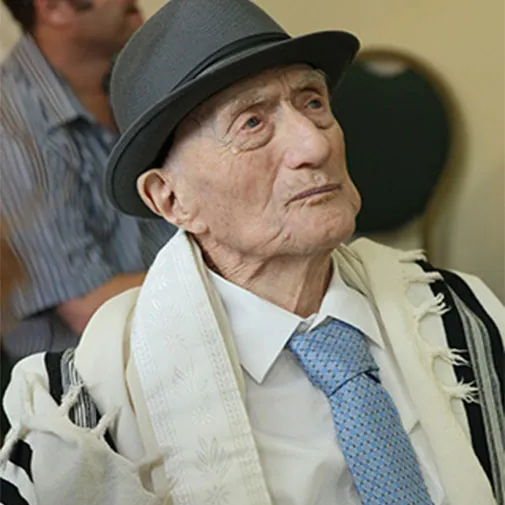
He died last August. But before his death at age 113, he was officially recognized as the world’s oldest living man.
But even more important to Mr. Kristal and his family – Yisrael was a Holocaust survivor.
In 1939, Yisrael was one of 160,000 Jews forced by the Nazis into the infamous ghetto in Lodz, Poland – a tiny area of only four square kilometers. Lodz had been home to the second-largest Jewish population in Europe after Warsaw. And all these people were jammed into an area that was horribly overcrowded, surrounded by barbed wire, and without adequate food, running water or sanitation.
Two of Yisrael’s sons died in the Lodz Ghetto before he and his wife were sent to the Auschwitz death camp, where she was murdered.
Kristal was the only member of his large family to survive – and just barely at that. When the camp was liberated, he weighed only 80 pounds.
But even so, Yisrael was one of the blessed few. The Nazi’s “Final Solution” exterminated an estimated 6 million Jews – two-thirds of Europe’s Jewish population. In countries like Poland, more than 9 out of 10 Jews perished – as Jewish men, women and children were imprisoned in city ghettos and death camps, where they were systematically starved, tormented, tortured and killed.
In the largest ghetto (Warsaw), between 4,000 and 5,000 were dying every month from hunger and related disease by the middle of 1941. Eventually the ghettos were dismantled and all surviving Jews were transported to camps for extermination.
But despite the gruesome efficiency of the Nazis, some Jews – like Yisrael – managed to survive. Many fled to Russia, Scandinavia, the United States or even Asia. Some remained in German-controlled Europe by assuming non-Jewish identities, or by hiding. And some simply outlasted the horror of the ghettos and camps.
Following the end of the war, many survivors fled to Palestine – and then to the new State of Israel when it was founded in 1948.
In the years following the war, many of these Israeli Holocaust survivors have died (with 13,000 more dying each year). But it’s estimated that as many as 175,000 still survive – with an average age of 83 years.
Unfortunately, even after all these dear people have suffered at the hands of the Nazis, their lives are still very difficult. A 2015 survey showed that about 45,000 Israeli Holocaust survivors live in poverty, surviving on such meager pensions that they sometimes choose between buying food, seeking medical care or heating their homes in winter.
In addition, half of Holocaust survivors say they feel “alone” – both from the deaths of family and friends, and the fact that most must live in apartments without elevators. So they seldom are able to go out.
Further, three out of five admit to worrying about their financial situation. And two out of five live in fear that the Holocaust will happen again.
Their already difficult lives are further complicated by the high cost of health care in Israel – including $100 for most eyeglasses, $500 for dental implants and $1,000 for dentures. So, many poor survivors must go without.
These elderly survivors of the Holocaust have already experienced the worst that man’s inhumanity can inflict, and now they deserve better than to continue suffering in their old age!
That’s why Jewish Voice Ministries is reaching out to help care for these dear men and women.
Working through our own office in Israel, and through other Messianic ministries we partner with, Jewish Voice is working to ensure that those survivors will no longer have to suffer. Right now, we’re providing:
God has called Jewish Voice to show His love for these, His people, so they will not have to feel the indignity of not being able to eat well, pay bills, read, buy needed medicine or meet other basic needs.
Through our connections, Jewish Voice gets excellent pricing on services in Israel. Because of this …
Just $25 can give sight to someone by providing them with a simple pair of eyeglasses.
Will you do your part by giving a gift now to bring compassion, healing and hope to a Jewish Holocaust survivor living in poverty in Israel?
I hope you’ll give generously.


Tu B’Shevat is the Jewish New Year for Trees

The shofar is a simple yet profound instrument of the Bible. It’s a key feature of Judaism’s Fall Feasts, particularly Rosh Hashanah and Yom Teruah.

What we can learn about gratitude from the Jewish tradition of “blessing” God.